HYROX sled push guide: weights, technique and training

Understand the sled weights, build steady leg drive and practise starts and turns without turning every session into a maximum effort.
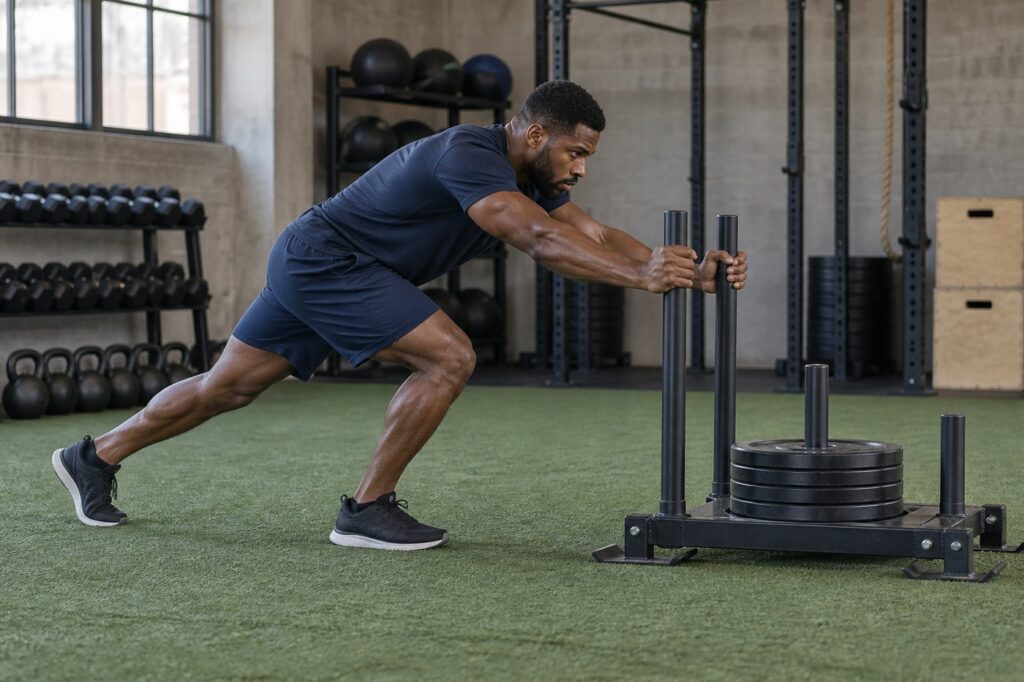
The sled push is easier to evaluate when you look beyond the plates. Your body position, the surface and the way you restart each length all affect the session. Begin with a load you can move deliberately and use a consistent setup to understand your progress.
Race requirements at a glance
Singles: 50 m. Clear each line with the entire sled before turning.
- Women Open
- 102 kg including sled
- Women Pro / Men Open
- 152 kg including sled
- Men Pro
- 202 kg including sled
Brief reminders checked on 8 September 2026. Read the 2026/27 singles standard for the full requirements. Other formats have their own rules.
Find a position you can keep
Set your hands on the handles and establish a firm, comfortable trunk position before moving. Lean into the sled and take compact steps, keeping pressure through the handles. Look for a position that allows continuous movement rather than repeated lunging and stalling.
Try small changes to your hand height with a light load. The useful choice is the one you can repeat without folding through your back or losing your footing. If a heavy push stops immediately, reset your feet and brace before trying again; do not use a collapsing position to rescue a technique set.
Common mistakes to watch for
- Testing the heaviest load every time. That makes it hard to practise starts and steady movement.
- Taking oversized steps. A shorter step may make your pressure easier to maintain.
- Skipping the reset. Practise getting organised at the end of a length as deliberately as you practise the push.
Practise starts, lengths and resets
Warm up with familiar easy movement and unloaded or lightly loaded pushing. Then complete up to 4 × 10 m at a manageable load, resting 60–90 seconds between lengths. Use the first two lengths to find your position and the next two to repeat it.
Record the sled model, plates, surface and whether each length stayed continuous. When those details remain the same, your notes become much more useful. If your footing slips or every step stalls, lower the load or shorten the distance. A smooth 5 m length can teach you more than an uncontrolled attempt to complete 10 m.
For progression, add a small amount of distance or load while keeping the other parts of the session steady. Do not increase the demand simply because the calendar says another week has passed.
Include the cost of restarting
A push plan should account for the ends of the lane. Rehearse a deliberate pause, repositioning and a clean restart. If you routinely spend a long time trying to restart after pushing to exhaustion, test a calmer first length or an earlier planned pause in training.
When the movement is established, follow a small amount of sled work with easy running and note how the change feels. This is a way to learn, not a requirement to finish every strength session with hard intervals.
Why gym weights do not tell the whole story
Keep comparisons within the same setup wherever possible. A different sled or surface can change the experience substantially. Treat race loading as one part of preparation rather than proof that matching the plate number guarantees readiness.
Common sled push questions
Do the listed weights include the sled?
Yes. The figures above are total sled loads, so do not add that amount in plates to an already weighted sled.
What if my gym has no sled?
You can continue general strength training with familiar exercises that suit your ability. Avoid improvised pushes against equipment that was not designed for it. Before racing, find a suitable facility where you can practise an actual sled, the footwork and the resets.
← Back to the Blog