HYROX farmers carry guide: weights, grip and controlled turns

Practise a stable carry, plan your set-downs and develop grip endurance without waiting for the weights to slip.
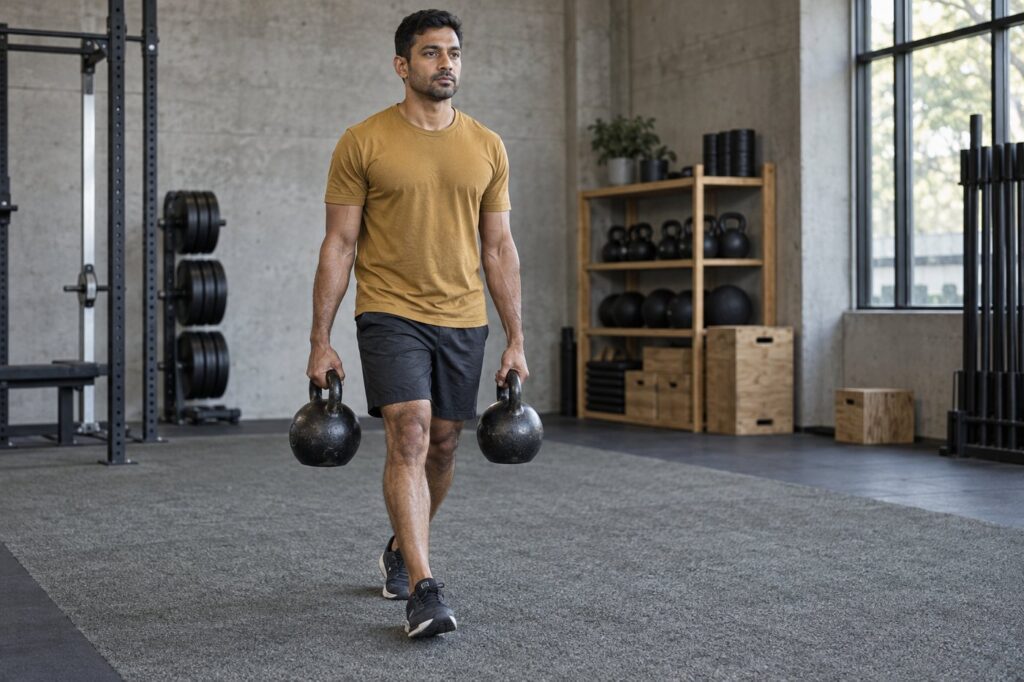
The farmers carry asks you to keep moving while holding a load on each side. The work includes picking the bells up, walking, turning and putting them down. Practise all four parts rather than treating the session as a contest to hold on for as long as possible.
Race requirements at a glance
Singles: 200 m. Carry both bells at your sides; return them upright to their box.
- Women Open
- 2 × 16 kg
- Women Pro / Men Open
- 2 × 24 kg
- Men Pro
- 2 × 32 kg
Brief reminders checked on 8 September 2026. Read the 2026/27 singles standard for the full requirements. Other formats have their own rules.
Keep the load close and the route clear
Begin with a deliberate pickup and a stable standing position. Let your arms hang long, keep the bells close to your sides and look along the route. Walk at a pace that lets you control the weights rather than swinging them to keep up with your feet.
Rehearse a turn before adding a demanding load. Give yourself enough space to change direction without clipping equipment or another person. If your grip needs a rest, stop and lower the bells carefully, then reset your posture before lifting again.
Common mistakes to watch for
- Waiting for the grip to fail. Plan the end of a practice bout while you still control the set-down.
- Only walking straight lines. Include turns in an appropriate clear space.
- Letting the bells swing. Reduce speed or load until the carry settles.
Make each carry look the same
After warming up and rehearsing lighter carries, try up to 4 × 30 m, with 60–90 seconds of recovery between bouts. Include one controlled turn in each bout. Choose weights that let you finish with stable posture and put them down deliberately.
Start with 15 m or lighter weights if that is more appropriate. The exercise should not depend on an emergency drop at the finish. Stop if you feel pain, numbness or cannot control the load.
Record the weights, distance, number of stops and whether the final turn was as controlled as the first. To progress, extend a bout slightly while keeping the load fixed, or use a modest load increase with the original distance. Choose one change, then review it.
Practise a useful rest
Experiment in training with where a short break makes sense for you. A planned set-down gives you a chance to reset rather than waiting for your hands to make the decision. Note how quickly you can resume a stable carry, not just how long you held on beforehand.
Do not assume that jogging with the bells is automatically the best option. Compare it with a purposeful walk only when you can control both. Your useful pace is the one that accounts for turns, stops and the condition in which you leave the station.
Common farmers carry questions
Are the weights listed per hand?
Yes. “2 × 24 kg” means two separate 24 kg kettlebells. Use the correct division when preparing your equipment.
Can I train with dumbbells?
Dumbbells can support general carrying practice. Their handles and shape will feel different, so they are not a perfect test of how race kettlebells will feel. Include some kettlebell practice before relying on a grip plan.
Should I do grip work every day?
Account for the pulling, carrying and other hand-intensive work already in your week. Add practice in a way you can recover from rather than treating tired hands as proof of a useful session.
← Back to the Blog