HYROX sled pull guide: weights, rope handling and pacing

Learn to organise the rope, control your footwork and practise the sled pull with a clear plan for each reset.
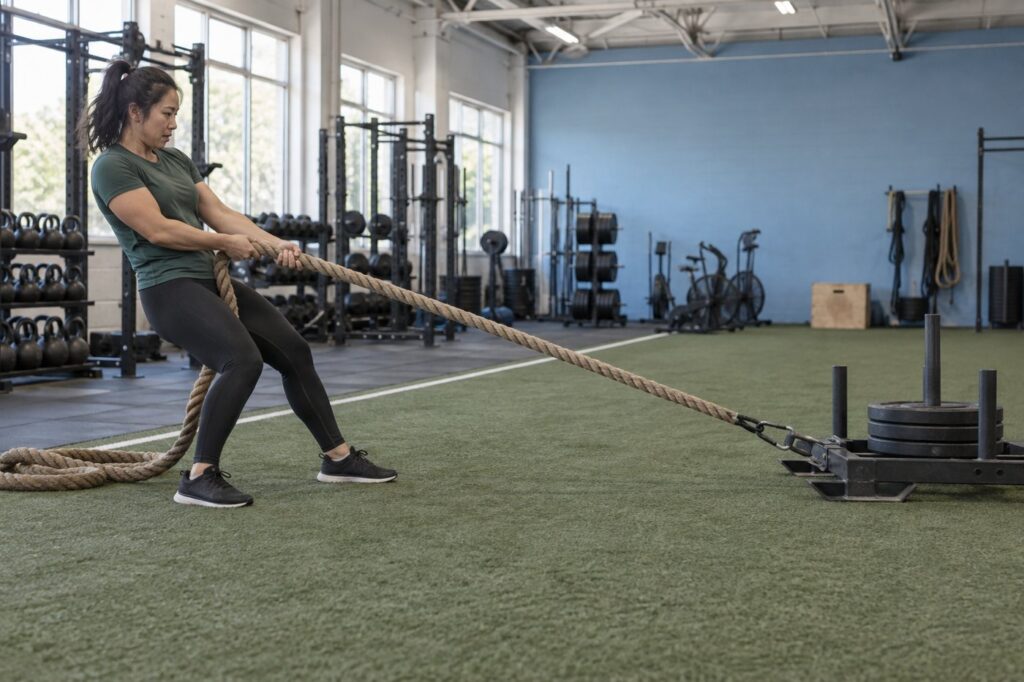
Sled pull practice should include the space around you. It is possible to develop pulling strength while still feeling unprepared for a rope that gathers at your feet. Build a repeatable setup before treating the load or stopwatch as the main challenge.
Race requirements at a glance
Singles: 50 m. Pull standing within your box; keep the rope clear of neighbouring lanes.
- Women Open
- 78 kg including sled
- Women Pro / Men Open
- 103 kg including sled
- Men Pro
- 153 kg including sled
Brief reminders checked on 8 September 2026. Read the 2026/27 singles standard for the full requirements. Other formats have their own rules.
Make room for the next pull
Mark a working area in the gym and check that the route is clear. Establish a balanced stance, take tension through the rope and brace before moving the sled. Coordinate your pull and footwork so that you can see where the next movement will take you.
Pay attention to where the slack collects. Rehearse arranging it away from your feet without stepping into another person’s space. When you reach the end of the space available to you, stop and reset deliberately. Unlimited backward walking in training can hide a problem that appears when the working area is smaller.
Common mistakes to watch for
- Watching only the sled. Check your feet and rope as part of the sequence.
- Pulling with repeated arm curls. Reduce the load while learning to involve your body in a controlled way.
- Rushing the slack. A quick pull followed by a tangle is not an efficient length.
A rope-management session
After a general warm-up and light rehearsal, try up to 4 × 10 m with 60–90 seconds of rest. Use a load that moves smoothly. Before every length, put the rope into an orderly starting position and decide where your feet will travel.
Measure success with three observations: whether you stayed balanced, whether the rope stayed clear and whether the next pull began without confusion. If any of those deteriorates, reduce the load or use 5 m lengths. Do not wrap the rope around your hands or body to compensate for a load you cannot manage.
Once the setup is reliable, keep the same equipment and add a little distance. Alternatively, keep the distance and practise a slightly shorter rest. Change one variable so you can understand why the session became harder.
Count the resets as part of the effort
Think of each length as a sequence of controlled pulls and organised resets. In your notes, distinguish time spent moving the sled from time spent rearranging the rope or recovering. That helps you identify whether the next useful step is fitness, technique or simply a clearer routine.
A short pause is useful when it lets you resume with control. Waiting until you are tangled or too tired to hold your position makes the decision for you. Practise recognising the point at which a reset improves the next few pulls.
Common sled pull questions
Why does the same weight feel different elsewhere?
A comparison changes when the sled, surface or equipment condition changes. Record your own setup and compare like with like. Avoid using another gym’s loading as a precise conversion for yours.
Will cable rows prepare me for the station?
They can be part of general pulling-strength work. They do not reproduce loose rope, restricted space or the transition between pulling and resetting. Keep those skills in the plan whenever suitable equipment is available.
Should every session use race weight?
No. A lighter practice session lets you learn the sequence. Build towards more specific demands as control and capacity improve, rather than using race loading as an entry requirement for learning.
← Back to the Blog